
The practical answer in this MBTI vs personality test comparison is that the difference depends on what the assessment measures and how its result is meant to be used. Four letters do not prove that a test is the official MBTI®. A free quiz can still be a useful conversation starter, but it should be described accurately and checked against your own experience.
Quick answer: are MBTI and personality tests the same?
Treating every four-letter result as the same test can make a category sound like a permanent ability or destiny. In an MBTI vs personality test comparison, official MBTI®, 16Personalities, independent 16-type quizzes, and Big Five personality measures can share familiar language while using different theories and scoring rules. Read the provider's explanation of what is measured instead of relying on the page title alone.
The Japanese MBTI Association states that the free 16Personalities test is separate from official MBTI and that its questions and result method are different. That clarification does not make a free quiz automatically useless. It helps you name the source correctly and prevents a casual online result from being presented as a professional MBTI assessment.
Choose by the question you need to answer. A short free quiz may be enough for a low-stakes conversation. A deeper self-reflection project may benefit from continuous trait scores, written examples, or a conversation with a trained practitioner. Do not use one type to make a medical decision, decide a hiring outcome, or judge another person's character.
| Name | Typical result | What to check |
|---|---|---|
| Official MBTI® | A type built from preference pairs | Official explanation and qualified guidance |
| 16Personalities | 16 types plus additional trait signals | Its theory is distinct from MBTI® |
| General personality test | A site-specific type or score | Method, evidence, and data use |
| Big Five | Five traits shown on continua | Scale definitions and intended use |
MBTI®, 16Personalities, and general personality tests
The MBTI® framework is associated with psychological type preferences such as how a person approaches information, decisions, and the outside world. A responsible explanation presents a result as a way to explore preferences, not as a permanent label. The administration, feedback, and documentation are part of the experience, so the instrument name alone is not enough context.
16Personalities uses familiar four-letter codes such as ISTJ and INFP, which is why readers often call it MBTI. Its published framework describes continuous traits and additional dimensions rather than simply reproducing the official MBTI method. Saying that someone received INFP on 16Personalities is therefore not the same as saying that the person completed an official MBTI assessment.
The phrase personality test covers many online services. They vary in question count, response scale, scoring, advertising, account requirements, and retention of answers. Before choosing one, check who operates it, what it measures, why the result is offered, whether retesting is explained, and whether cookies or analytics are used. A short quiz can start reflection, but it cannot describe every part of a complex person.
- Four letters alone do not establish that a test is official MBTI®
- Read theory, questions, scoring, and feedback as separate claims
- Check registration, cookies, and result storage before answering
- Be cautious when a page uses absolute or fear-based language
Type categories vs Big Five traits
A type model combines several preferences into a category that is easy to remember and share. A type name can give friends or teammates a common vocabulary quickly. The trade-off is that someone near a boundary may feel forced into one box, and the range of behavior that appears in different settings can be forgotten.
The Big Five describes traits such as openness, conscientiousness, extraversion, agreeableness, and emotional stability along continua. Instead of placing someone in one of 16 boxes, a trait profile asks how strongly a tendency appears relative to a scale. That makes nuance easier to discuss, although the result takes more time to interpret.
Neither format is automatically the right answer for every purpose. A type can be a map for starting a conversation, while a trait score can be a note for comparing experiences and degrees. If a website uses the Big Five name, still check its questions, scale anchors, and interpretation range; the model label is only the beginning of the explanation.
High is not the same as good. A lower level of extraversion can support concentration or one-to-one conversation, while a higher level of conscientiousness can still create friction when plans must change. Treat a score as a description of a tendency, never as a ranking of human value.
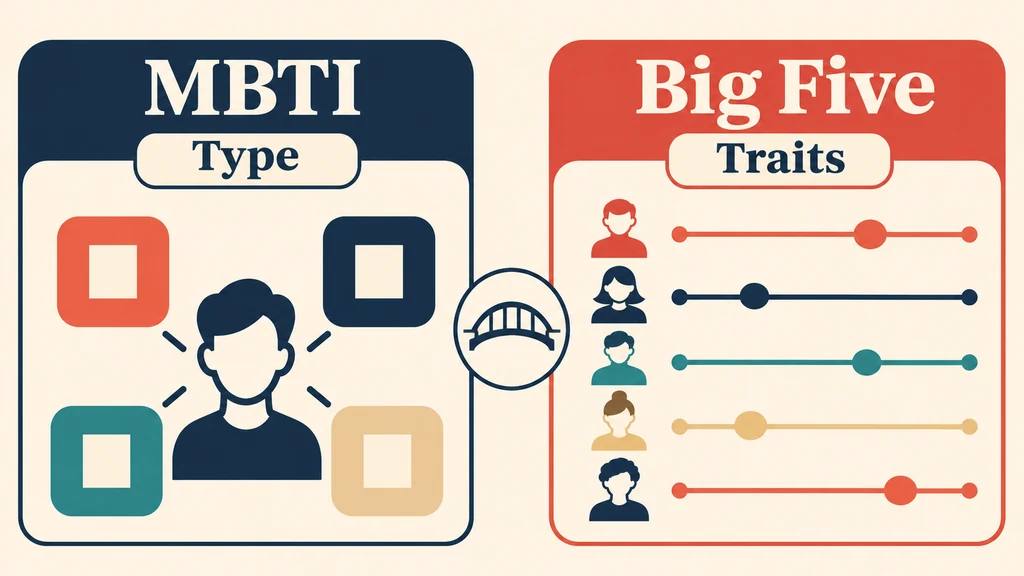
| Axis | Type-oriented view | Trait-oriented view |
|---|---|---|
| Result | A category with a short description | A degree on each trait |
| Sharing | A memorable type name | More context and scale detail |
| Useful for | Conversation and self-introduction | Comparing patterns across experiences |
| Main caution | Do not become the box | Do not turn points into worth |
Why results change and how to read them
It is normal for a result to move when the same person answers on a different day. The wording of a question, a recent event, fatigue, a role at work, and the available response options can change which experiences come to mind. Instead of asking which result is the one true self, note the questions that felt difficult and the situations behind them.
First identify what the report actually describes: a general preference, a work behavior, or a choice made in that moment. Do not infer an ability or a future that the report never measured. Then collect two examples that fit the description and two that do not. A counterexample is useful information about context; it is not proof that you failed the test.
For a trustworthy reading, check question transparency, repeatability, stated limits, and data retention. A short free quiz cannot by itself establish the full scientific validity of a complex psychological measure. For a major education, work, or relationship decision, combine the result with experience, official information, and appropriate professional advice.
Choose a test by purpose
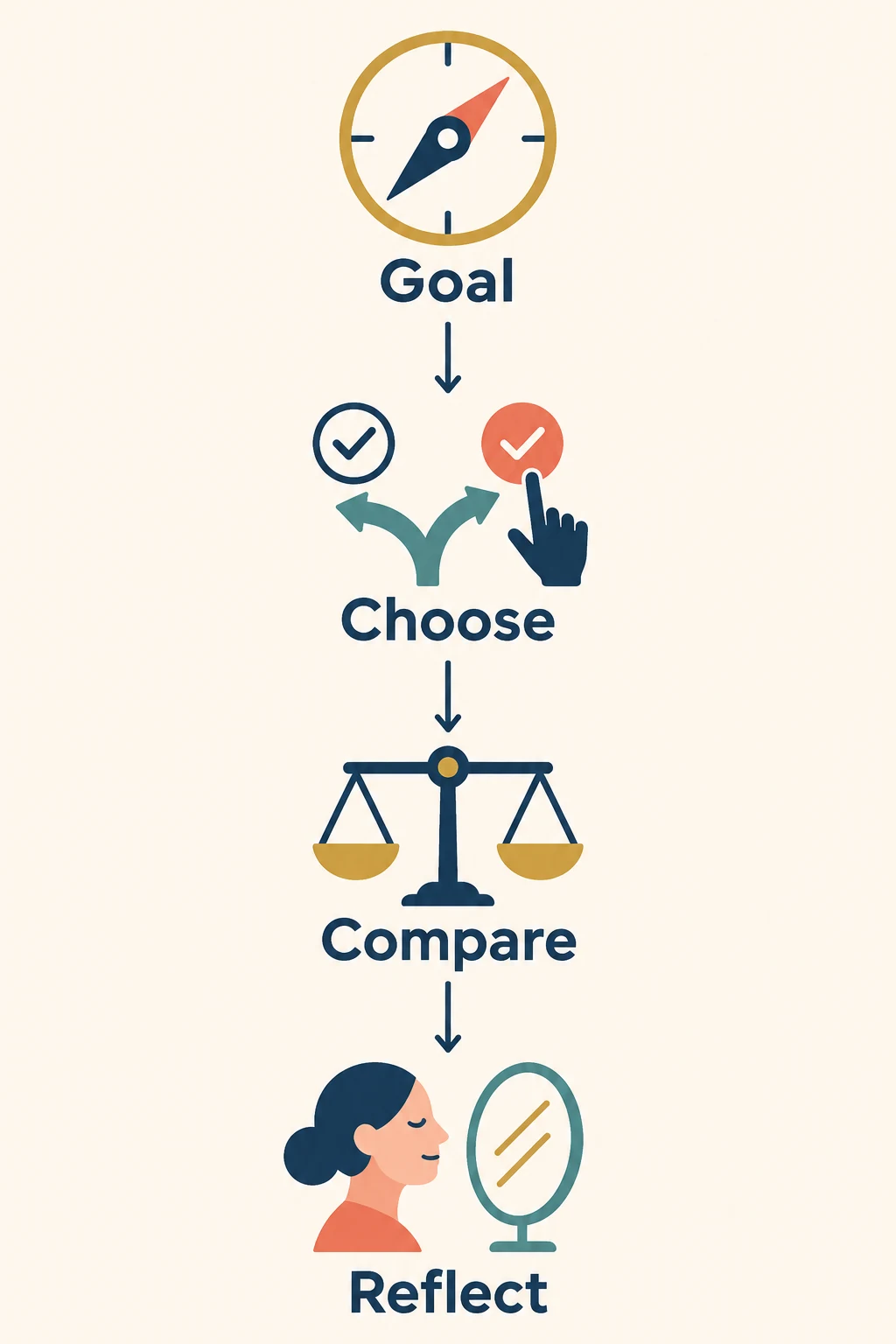
Write one sentence about what you want to know: a conversation topic, a pattern in your own behavior, or a way to discuss collaboration. The more precise the question, the less likely you are to be pulled toward dramatic labels or a ranking. A test should answer a modest question, not replace your whole self-description.
For a quick, low-stakes conversation, choose a free test that states its question count, result format, and sharing controls. Before posting, check whether your email, birthday, or response history is stored. Share your own result only as far as you choose, and never publish another person's result without permission.
For deeper self-reflection, use this MBTI vs personality test comparison as a starting point and combine a type label or trait score with concrete experiences. Big Five scores are not grades, and a lower score is not a defect. Write down when a tendency appears, when it does not, and which conditions make an action easier. That turns a general result into a useful question.
In a workplace, use personality language only as a voluntary conversation aid. Do not use a type for hiring, promotion, access to support, or a judgment about effort. Discuss observable tasks, skills, preferences, and working conditions instead.
- State the purpose in one sentence
- Check the provider, questions, scoring, and data use
- Compare the result with examples and counterexamples
- Use more than one source for a high-stakes decision
Avoid labels, hiring shortcuts, and privacy risks
Statements such as 'I cannot change because of my type' or 'they act that way because of their type' turn a reflection aid into a stereotype. Behavior also depends on role, culture, health, experience, relationships, and the setting. Treat a result as a prompt for a question, and give priority to what a person says and does in context.
Do not make a hiring or performance decision from a personality label. Sorting people by type can hide skills, learning opportunities, and the conditions in which someone performs well. If a team chooses to discuss preferences, let each person decide what to share and translate the conversation into concrete ways of working, communicating, and asking for support.
Before taking a free quiz, read the fields requested, cookies, analytics, advertising use, and retention period. You can close a page that demands excessive personal information or rushes you toward registration. Choosing a different test is a reasonable privacy decision, not a failure to finish.
- Do not link a type to ability, morality, or future success
- Do not share another person's result without consent
- Check privacy and deletion information before answering
- Do not explain a serious concern with a label alone
Five steps to compare and choose
Once you understand the difference between MBTI and personality tests, use this order to choose a responsible next step.
Choose one goal such as conversation, self-reflection, or a work discussion.
Check whether the page describes official MBTI®, 16Personalities, another type quiz, or a Big Five measure.
Review requested fields, cookies, result storage, deletion, and sharing before you answer.
Write two examples that fit and two that do not, then look for the context behind them.
Test one communication or work adjustment and update your view from what actually happened.
MBTI vs personality test FAQ
Is 16Personalities the official MBTI®?
No. The Japanese MBTI Association explains that the free 16Personalities test is separate from official MBTI and uses different questions and result methods.
Should I choose MBTI or Big Five?
It depends on your goal. A type can make a short conversation easier, while a continuous trait profile can help you compare degrees and experiences. Neither is a measure of human worth or a guaranteed ability test.
Do free personality tests have value?
They can be a starting point for self-reflection when the method and privacy terms are clear. Do not use a short quiz as a medical, hiring, or relationship verdict.
Why can the same test give a different result?
Context, wording, recent experiences, and response boundaries can change an answer. Record where you were unsure and what was happening instead of treating one result as a permanent identity.
Is it safe to share a result on social media?
Check whether answers and contact details are stored and whether the audience can be limited. Share your own type only as far as you are comfortable, and never post another person's result without consent.
Limits of this guide and personality tests
This article is an MBTI vs personality test comparison that explains terminology and measurement styles; it does not establish the medical validity, hiring predictive power, or future success of any particular assessment. For official MBTI® information, use the official organization and qualified practitioner guidance.
Our free personality test is a self-reflection prompt, not a clinical assessment, therapy service, or hiring decision. If a result increases distress, step away from labels and speak with a trusted person or an appropriate support service.
- Do not confuse a test's name with its purpose
- Do not turn a type or score into ability, career, or character
- Review storage and sharing policies for personal data
- Use experience, skills, and conditions alongside a test result
Primary and reference sources
These sources were checked for the boundary between official MBTI and online 16-type tests and for the model descriptions. Read external explanations as source-specific claims; the practical guidance is stated in this article.
- Japanese MBTI Association: For people who mistook 16Personalities for MBTI® Explains the distinction between the free test and official MBTI and warns against fixed labels
- 16Personalities: MBTI vs. 16Personalities Official comparison of theory, scales, and reliability
- Myers & Briggs Foundation: Is the MBTI Assessment a Test? Explains the assessment name and self-report format
Set a purpose, then check your tendencies
Our 16-question test is a free self-reflection tool, not an official MBTI® assessment. Keep the result as a working hypothesis and compare it with your experiences using the five steps above.
Try the free personality test